Starlink Block 5: What to Know Before You Upgrade

A Starlink Block 5 upgrade may involve more than just replacing the antenna. For an aircraft with an existing Block 3 or Block 4 installation, the scope depends on the hardware already installed and the approved data available for that specific aircraft.
For operators considering a Block 5 upgrade, three factors can shape the decision: the aircraft’s current configuration, the certification pathway available, and the equipment, labor, and downtime required. Operators should understand their current configuration to determine what their Block 5 upgrade may involve.
The Differences Between Starlink Block 3, 4, and 5
Many business aviation aircraft with Starlink use the Block 3 Aero Terminal. Block 4, used on certain Dassault Falcon aircraft, succeeded Block 3 and updated the system’s internal hardware, including Power Supply Unit (PSU), Wireless Access Points (WAPs), and associated wiring.
Block 5 introduces the current-generation Performance Antenna. When the approved configuration permits, a Block 5 may use existing Block 4 internal hardware. The Performance Antenna is narrower than the Block 3 antenna but similar in length. The approved installation data determines whether an adapter may be used with the existing antenna fairing and structural mounting provisions.
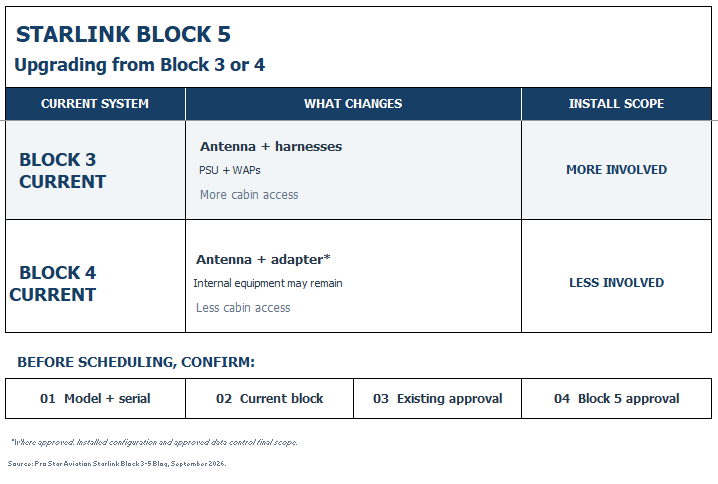
These differences create two distinct upgrade paths. A Block 4 aircraft may retain its existing PSU, WAP, and wiring, while a Block 3 will require new internal equipment and wiring in addition to the new antenna. The aircraft’s installed configuration and approved data determine the final scope.
What a Block 4-to-Block 5 Upgrade Involves
For a Block 4 aircraft, the conversion typically replaces the existing antenna with the Block 5 Performance Antenna and the applicable adapter. When the approved configuration permits, the operator may retain the existing PSU, WAPs, and wiring. Because the project may not require internal equipment replacement, the conversion may require less interior work than a Block 3 upgrade.
What a Block 3-to-Block 5 Upgrade Involves
A Block 3-to-Block 5 conversion generally requires more extensive work. The project typically replaces the existing antenna, external and internal wiring harnesses, PSU, and WAPs. The newer internal components may have different form factors, so the project may also require mounting modifications.
The new wiring must run from the antenna through the aircraft’s pressure vessel to the PSU and WAP, which can require removing a significant number of interior components. Although the existing antenna fairing and structural mounting provisions may remain, the interior work makes a Block 3-to-Block 5 conversion substantially more involved than a Block 4 upgrade.
Certification Requirements for a Block 5 Upgrade
A Block 5 conversion also requires an approved certification pathway for the specific aircraft and installation. Depending on the aircraft type and the approval basis for the original installation, the certification pathway may require an amended STC or other approved data that addresses the Block 5 configuration.
Specific requirements depend on the aircraft type and the STC covering its original Starlink installation. Operators should confirm that an approved Block 5 solution is available for their aircraft and that the modification complies with the applicable STC before scheduling the upgrade.
Upgrade Costs and Downtime for Block 3 and Block 4
Equipment costs differ between the two upgrade paths. For Block 3 operators, the conversion requires most or all of a new Block 5 equipment set. The antenna represents approximately 80% of the equipment cost, while the PSU, WAP, and wiring account for the remaining 20%. Block 4 operators also pay for the Block 5 Performance Antenna, which represents most of the equipment cost, but they may retain their current PSU, WAP, and wiring.
Labor and downtime are additional considerations. A Block 3-to-Block 5 conversion could require roughly two weeks of aircraft downtime, depending on the aircraft and installation. The additional time is largely driven by the interior work needed to access and replace the PSU, WAP, and wiring.
A Block 4 conversion, meanwhile, requires considerably less labor because the existing internal equipment and wiring can remain in place. This, in most cases, will result in a shorter downtime period comparatively.
When to Consider a Block 5 Upgrade
For new Starlink installations, Block 5 is the current configuration for operators to evaluate as certification becomes available for additional aircraft. For Block 4 operators, the decision to upgrade is primarily about gaining access to the Performance Antenna and its enhanced capabilities, while also justifying the project cost and downtime. Block 3 operators can plan for the transition rather than treat it as an immediate requirement. Currently, Block 3 equipment is no longer in production, while replacement components still remain available. Because support and parts availability can change, operators should confirm the current status when planning an upgrade.
The appropriate timing depends on the aircraft’s current configuration, the availability of an approved Block 5 solution, desired service capabilities, current equipment and labor estimates, parts availability, and downtime. For Block 3 aircraft in particular, planning ahead may provide greater flexibility in deciding when to schedule the conversion and how to coordinate it with other maintenance or interior work.
Considering a Starlink Block 5 upgrade?
Talk with the Pro Star Aviation team about your aircraft’s current system, approval requirements, and how an upgrade could fit your maintenance schedule, call (603) 627-7827.